How Certification Exams Actually Think
Every exam grades against a reasoning frame — Exam Lens, Security Triad, SHRM Competency. Here's how to name the frame behind a question, and what to do when drilling more facts stops moving your score.
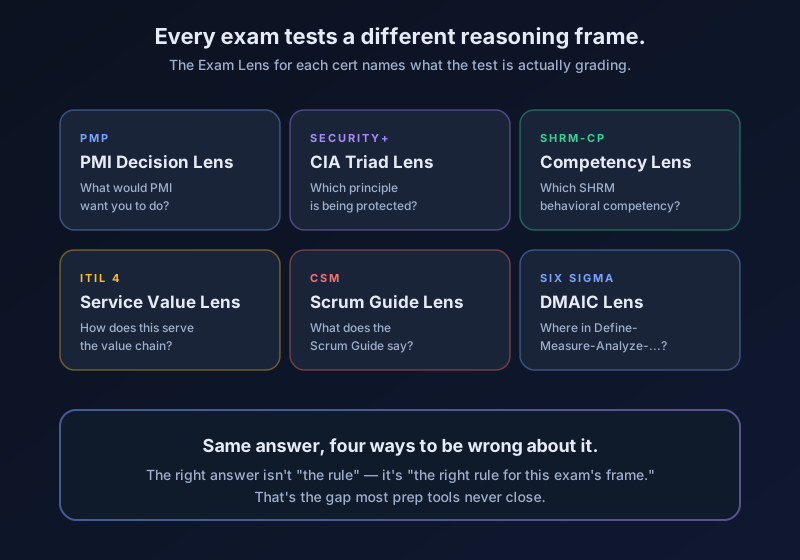
I've spent the last two years building a tool that prepares people for certification exams. The thing nobody warned me about: coverage and reasoning are two different problems, and it is easy to spend months solving only the first one.
They drill you on facts. The exams don't test facts. Not really.
Take a project manager studying for the PMP. She memorizes the 49 processes, the ITTOs, the formulas. She runs flashcards until they're rote. Then she sits the exam and the first question is: "A team member tells you in a 1-on-1 that another team member is taking credit for her work. What do you do?"
None of the answer choices are wrong, exactly. They all sound reasonable. One of them is what PMI wants you to do.
That last sentence is the whole game.
Exams test a frame, not a fact
When the PMI writes a question, they aren't asking what you remember. They're asking whether you think like a PMI-certified professional would think. That's a totally different cognitive task. You can know every fact in the PMBOK and still fail because you keep picking the answer that's practically right instead of the one that's PMI-doctrinally right.
This isn't unique to PMP. Every major certification I've studied has the same structure:
- CompTIA Security+ isn't asking you to recite firewall rules. It's asking which principle of the CIA triad (confidentiality, integrity, availability) is being protected by a given control, and what attack vector breaks it. The reasoning frame is Security Triad thinking.
- SHRM-CP isn't asking what HR best practice says — it's asking what a SHRM-certified HR business partner would do against the SHRM Body of Applied Skills and Knowledge, with all nine behavioral competencies in play. The reasoning frame is SHRM Competency thinking.
- PMP asks what PMI would have you do. The reasoning frame is Exam Lens thinking.
Each certifying body has a worldview. The exam grades you on how well you've absorbed that worldview, not on how well you've memorized that body of knowledge. Those are different things, and the practice gap between them is where almost everyone fails.
Why flashcards can't bridge it
Here is the test worth running on whatever you are studying with, including this one. Take ten questions you got right and ask what each was measuring: could you have answered it from a definition, or did you have to weigh two defensible options and pick the better one? The certifying bodies write most high-stakes questions at the apply / analyze / evaluate level. If your practice sits mostly at remember and understand, more of it will deepen your bench of facts without changing the decision you make under pressure. That is a gap in the mix, not a verdict on any one tool — plenty of good courses and banks drill the higher levels, and the only way to know about yours is to look.
I wrote about this in detail in Study by Bloom's Level — if you only read one post on this site, read that one. And Why Recall-Only Prep Fails has the cognitive-science backing.
What we built instead
Three things, basically.
- Every question is classified by Bloom's level. When you practice, you can see whether you're answering an "evaluate"-level scenario question correctly, or just nailing the easy "remember" stuff. The Cognitive Heatmap makes this visible.
- Every explanation walks you through the exam's reasoning frame. For PMP, that's the Exam Lens — what would PMI want you to do? For Security+, it's the Security Triad — which leg of the CIA triad is this question protecting? For Network+, it's the OSI Lens — which layer does this problem actually live at? The framework is built into how the AI explains every answer. You don't just learn the answer; you learn the lens you're supposed to read the question through.
- The system tracks your thinking traps. Not which topics you're weak on — most prep tools do that — but which kinds of reasoning errors you keep making. The patterns are surprisingly consistent per person.
The shift
The first time someone tells me "the exam stopped feeling like a trick" — usually around their second or third week — it's always the same realization. They stop hunting for the right fact in the answer choices and start asking which choice fits the lens. The exam writers were never trying to fool them. They were testing whether the candidate had internalized the frame.
That's what certification exams actually test. And once you can see the frame, you can read the question the way the people who wrote it did.
If you're weighing prep tools right now, I put the comparison in writing rather than in a pitch: choosing a PMP exam simulator for the 2026 exam.
— Dave
Try CipherExam for 14 days, free.
No credit card. Pick your exam, answer ten questions, and you'll see what I mean.
Cancel anytime.