Study by Bloom's Level: The Cognitive Framework That Separates Exam Winners From Flashcard Losers
Most exam prep teaches you to remember. The PMP, Security+, and CSM test whether you can apply, analyze, and evaluate. Here's the framework that explains it — and why it's the only one that maps to how these exams are actually written.
If you've ever walked out of a PMP, Security+, or CSM exam thinking "I knew the material — why did I fail?" — this article is the answer.
You didn't fail because you didn't know the material. You failed because the exam wasn't testing what you studied.
You studied to remember. The exam tested whether you could apply, analyze, and evaluate. Those are different cognitive skills. They require different study methods. And no flashcard app on the market teaches you the difference.
This is the foundation of every serious professional certification — and it has a name: Bloom's Taxonomy.
What Bloom's Taxonomy Actually Is
In 1956, educational psychologist Benjamin Bloom published a framework that classified learning into six cognitive levels, ordered from lowest complexity to highest:
- Remember — recall facts, terms, basic concepts
- Understand — explain ideas or concepts
- Apply — use information in new situations
- Analyze — draw connections, compare, contrast
- Evaluate — justify a decision or judgment
- Create — produce new or original work
Seventy years later, every major credentialing body uses Bloom's — or a direct derivative of it — to write exam items.
- →The PMP Examination Content Outline weights nearly every task toward application and analysis. PMI states explicitly that questions are situational and require judgment, not recall.
- →The CompTIA Security+ blueprint includes performance-based questions designed to test application and analysis in simulated environments.
- →The Scrum Alliance CSM exam tests understanding and application of Scrum in real-team scenarios — not memorization of the Scrum Guide.
- →The SHRM-CP exam splits items between knowledge questions (lower Bloom's) and situational judgment items (upper Bloom's), with the situational items carrying disproportionate weight.
- →ITIL 4 Foundation is the rare entry-level exception — heavily Remember/Understand — but every ITIL credential above Foundation shifts immediately to Apply/Analyze.
Read that again. The people writing your exam are using Bloom's. If you're not using Bloom's to study, you're preparing for a different test than the one you'll sit.
The Cognitive Mismatch That's Costing You the Exam
Here's what typical certification prep looks like: flashcards (ITTO charts, CIA triad acronyms, Scrum events), question banks with rationales, lecture videos and bootcamps, summary sheets and cheat cards.
What cognitive level do all of these train? Remember and Understand. The bottom two rungs.
What does the exam test? Primarily Apply, Analyze, and Evaluate. The top three rungs.
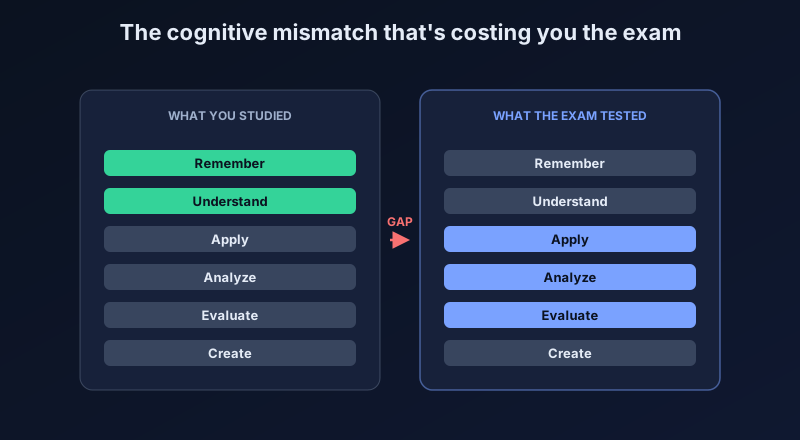
You're studying level 1-2 content for a level 3-5 exam. Then wondering why "knowing the material" didn't translate. This is the single biggest unforced error in certification prep. It's not laziness. It's not bad memory. It's a framework mismatch — and it's invisible to candidates because nobody teaches them to look for it.
The Six Levels, Translated to How You Actually Study
Generic Bloom's explanations give you verbs ("define, classify, compare") and leave you to figure out the rest. That's useless. Here's what studying at each level actually looks like for CIPHER's supported exams.
Example (Security+): Which port does LDAPS use by default?
How to study: Spaced repetition, flashcards, mnemonics. The only level where flashcards are the right tool. 15-20% of your study time.
Example (CSM): Explain the difference between a Sprint Goal and a Product Goal.
How to study: Teach the concept out loud, from memory, without notes. Feynman technique. 15-20% of your study time.
Example (PMP): A sponsor requests a major scope change mid-sprint. Three stakeholders disagree on direction. What is the project manager's BEST next action?
How to study: Practice problems with varied contexts. Never study the same scenario twice. 25-30% of your study time. This is where the exam lives.
Example (Security+): A user reports that their workstation is running slowly. The security log shows four anomalies in the past 24 hours. Which is the analyst's priority concern?
How to study: Scenario-based practice with deliberate noise. Train yourself to separate signal from distractor. 20-25% of your study time.
Example (SHRM-CP): Given three possible responses to an employee harassment complaint, which represents the BEST use of HR resources while minimizing legal exposure?
How to study: "Best answer" practice with written justification. For every question, write why this answer beats the other three. 10-15% of your study time.
How to study: Performance-based simulations (Security+ PBQs, A+ Core 2 PBQs, Six Sigma improvement projects). 5-10% of your study time if applicable.
The Study-Time Allocation Most Candidates Get Wrong
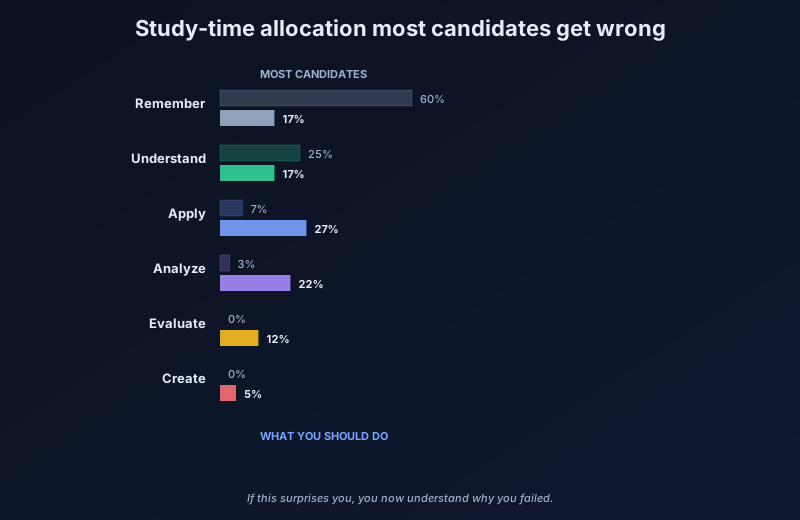
If this surprises you, you now understand why you failed.
How to Diagnose Your Own Cognitive Weakness
Most candidates can't tell you what level they're weak at. They only know their overall score. Overall scores are useless for study planning. Run this 30-minute self-audit:
- Pull 20 practice questions from a reputable bank for your exam.
- Before answering, classify each question by Bloom's level (use the verbs: list/define = Remember; explain = Understand; which action/BEST step = Apply; priority/most relevant = Analyze; best response = Evaluate).
- Answer each question. Mark right/wrong.
- Calculate accuracy per level. Not overall. Per level.
The level with your lowest accuracy is where 80% of your remaining study time should go. Not "the domain I'm weakest in" — the cognitive level I'm weakest at, across all domains.
Example: a PMP candidate who scores 70% overall but drills into Bloom's-level accuracy and finds 92% on Remember, 85% on Understand, 58% on Apply, 42% on Analyze. That candidate's problem isn't "I need to restudy Risk Management." It's "I can recall the material but can't choose between competing actions in scenarios." Two completely different study plans.
How CIPHER Implements This
CIPHER classifies every question in every practice session by Bloom's level. After any diagnostic, you see exactly where your cognitive profile is weak — not just "you're bad at Domain 2," but "you can remember the knowledge area but can't apply it in a scenario with competing stakeholder pressure."
Then the study plan reallocates your time to close that specific gap, using the method that matches the level. If your weakness is Apply, you get more novel-context scenarios. If it's Analyze, you get scenarios with deliberate noise. If it's Evaluate, you get "best answer" justification drills.
It's the framework the exam writers use, applied to how you study. Across PMP, CompTIA Security+, Network+ and A+ Core 2.
See where you're actually weak.
CIPHER runs a cognitive-level diagnostic across every exam it supports. In about ten minutes you'll know what's really blocking your score.
No credit card required.