Why Recall-Only Prep Fails High-Stakes Certification Exams
Flashcards and question banks stop working at around 70%. The cognitive science explains why — and what to do instead on the PMP, Security+, Network+ and A+ Core 2. The answer isn't more repetitions.
There's a pattern every serious certification candidate eventually hits. Week 1-4: you learn new material. Practice scores climb fast. Week 5-8: scores plateau in the low 70s. Week 9+: you grind more flashcards, more question banks, more rewatch. Scores do not move.
You're not lazy. You're not unintelligent. Your prep method has a ceiling — and you've hit it.
The ceiling is cognitive, not motivational. This article explains why, what the cognitive science actually says, and what to do instead.
The 70% Plateau Is Mathematical, Not Personal
Certification exams — PMP, Security+, CSM, SHRM-CP, ITIL 4, Network+, A+ Core 2, Six Sigma Green Belt — are written with a specific cognitive distribution. The average high-stakes certification exam breaks down roughly like this:
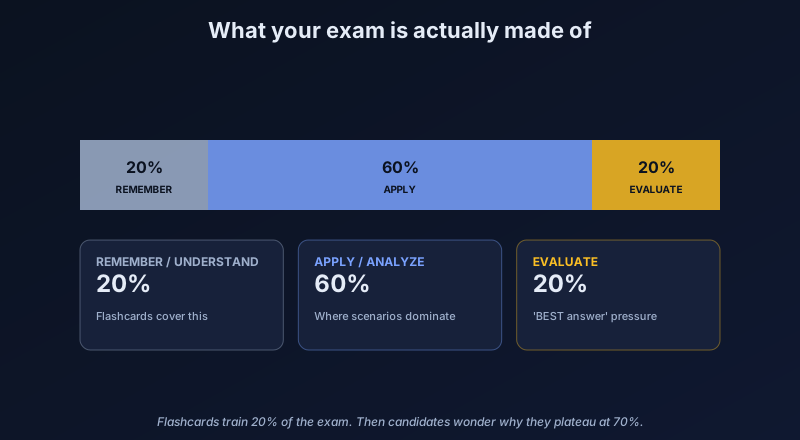
Flashcards and standard question banks train the first 20% well. They partially train the second bucket. They do not train the third bucket at all.
Ceiling math: max score from pure recall training ≈ 25% (from Remember) + 30% (from easier Apply items solvable by recognition) = ~55% on a strict exam, 65-75% on a generous one.
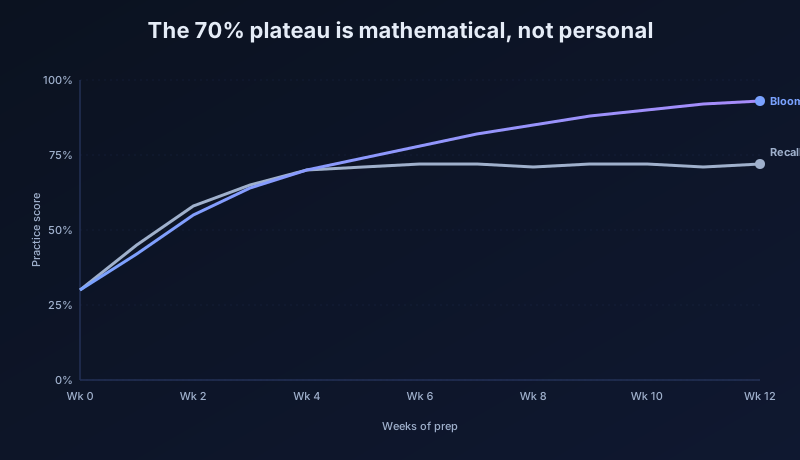
That's your plateau. You're not stuck. Your method has a ceiling, and you've reached it. Candidates who break through 80% and 90% aren't grinding harder. They're training the other two cognitive levels.
Three Cognitive Science Findings That Explain the Ceiling
1. Retrieval Is Not the Same As Application
The testing effect (Roediger & Karpicke, 2006) established that retrieving information from memory strengthens memory more than re-reading. This is real. It's why spaced repetition works.
What got mistranslated into exam prep products: "if retrieval strengthens memory, and the exam tests your memory, then more retrieval = higher score."
This is false. The exam doesn't test your memory. It tests your ability to use the information you've memorized to choose the best action in a scenario you haven't seen. That's a different cognitive operation. Retrieval practice builds the raw material. It doesn't teach the use of the material.
2. Transfer Is Context-Dependent
Decades of transfer research since Thorndike (1901): the more similar the practice context is to the test context, the better the transfer. Flashcard context is isolated question, isolated answer, instant feedback. Exam context is long scenario with irrelevant details, four plausible-sounding options, one "best" answer, time pressure. These are not similar contexts. Skill built in the flashcard context transfers poorly to the exam context.
This is why candidates who can recite every PMBOK process freeze on a PMP scenario item. They built the skill in one context and are being tested in a different one.
3. Recognition ≠ Production
Multiple-choice gives you the right answer in the options. Your job is to recognize it. Recognition is a weaker cognitive skill than production.
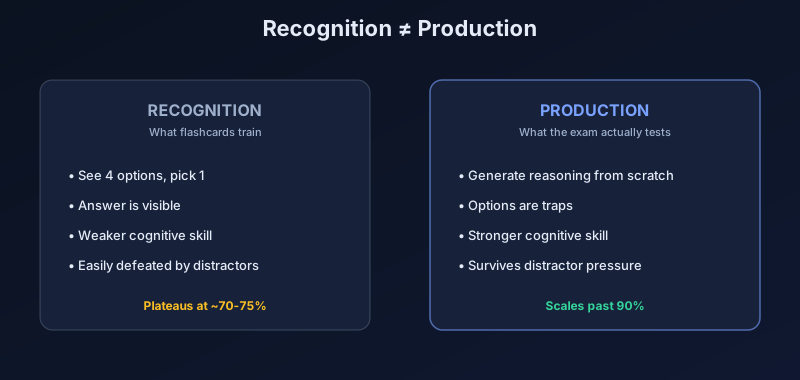
If you're losing points on questions where you narrow to two answers and guess — you're operating at recognition level and the distractor designers are beating you.
The Three Skills You Have to Train Separately
If your exam is Apply- and Analyze-heavy, three skills need direct training. None of them are built by flashcards.
Why flashcards fail: Flashcards give you the concept decontextualized. The exam gives you the scenario without naming the concept. You have to supply the concept yourself.
How to train: Force yourself to name what framework you're applying before looking at the answer options. "This is a risk response selection question." "This is a Scrum anti-pattern question."
Why flashcards fail: Flashcards don't have distractors.
How to train: For every practice question, after answering, write one sentence per wrong answer explaining why it's wrong. Not "it's not the best answer." Why specifically.
Why flashcards fail: Flashcards have one right answer. The hard exam items have two defensible answers and a scoring rubric that rewards one over the other.
How to train: "Best answer" justification writing. For every question you get down to two options on, write the explicit argument for why option A beats option B on the criteria the exam cares about.
The Real Reason "Just Do More Practice Questions" Stops Working
At some point every candidate is told: "just do more practice questions." It's partially right. But here's what happens when you do it without the work on top:
- →You memorize the question bank. Accuracy climbs. Real understanding doesn't.
- →You plateau at the bank's score, not the exam's score.
- →When you see a new scenario on exam day, you're back at your real skill level.
Practice questions work if you're doing distractor analysis and tradeoff evaluation on top of them. They don't work if you're just running more reps.
The Prep Loop That Breaks the Plateau
- Diagnose by cognitive level, not topic. Find out which Bloom's level is dragging your score.
- Train at the level that's weak. Apply-weak? Novel scenarios. Analyze-weak? Scenarios with deliberate noise plus forced distractor writeups. Evaluate-weak? "Best answer" justification essays.
- Re-diagnose weekly. Level-specific weakness moves fast. A profile taken two weeks ago is stale.
- Keep flashcards as maintenance, not offense. 10 minutes/day to hold your recall floor. Not your primary work.
How CIPHER Breaks This Loop Automatically
Every question in every CIPHER bank is classified by Bloom's level. Your accuracy per level is tracked separately from your accuracy per topic. The study plan targets your weakest level first, using the method that trains that level.
Distractor analysis is built into every question review. You see the reasoning for each wrong answer, not just the right one. Tradeoff evaluation shows up in "BEST" questions with the scoring rubric revealed in the rationale.
You don't have to design this loop. CIPHER runs it. Across all four live credentials.
Stop plateauing. See what's actually blocking your score.
CIPHER's diagnostic shows your Bloom's-level weakness profile in 20 minutes. The study plan reallocates automatically.
No credit card required.