Cognitive Heatmap: How to See Exactly Where You're Weak on the PMP, Security+, and Every Other Certification You're Prepping For
Overall scores tell you nothing. A cognitive heatmap maps your accuracy across Bloom's levels and exam domains, revealing your real weakness in under 20 minutes. Here's how to build one — and why CIPHER runs it automatically.
Your practice test score tells you one number. It's the least useful number in your prep.
"73%" doesn't tell you what to study next. It doesn't tell you whether you're weak on the material or weak on the reasoning. It doesn't tell you whether another two weeks of the same study plan will move the number or just waste time.
A cognitive heatmap does all three. And you can build one in under 20 minutes.
What a Cognitive Heatmap Actually Is
A heatmap is a two-axis grid. For certification prep, the axes are:
- →Vertical: Bloom's Taxonomy level — Remember, Understand, Apply, Analyze, Evaluate.
- →Horizontal: Exam domain — e.g., for PMP: People, Process, Business Environment. For Security+: Threats, Architecture, Implementation, Operations, GRC.
Every cell in the grid is your accuracy when the question is at that domain AND that cognitive level.
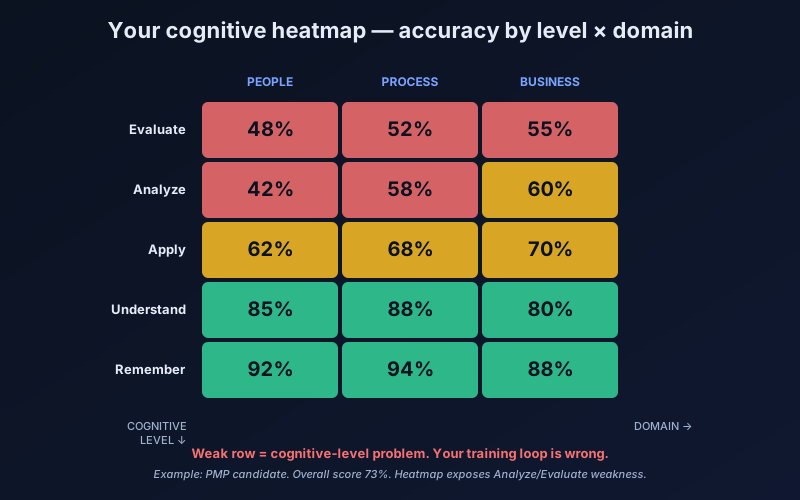
What you see is not "I'm weak on Risk" or "I'm weak on Apply." It's "I can remember Risk material but I cannot analyze a Risk scenario." Two completely different study problems. Same overall score. This is the view that tells you what to do next.
What an Overall Score Hides
Two candidates, same exam, same practice test, both score 73%.
Both at 73%. Same score. Totally different problems.
Candidate A is memory-rich, reasoning-weak. More flashcards is the worst possible next move. They need scenario and "best answer" work. Candidate B is the opposite. Strong reasoning, shaky fact base. They need exactly what Candidate A needs to stop doing — more spaced repetition on the fundamentals.
Give both the same advice ("study Domain 3 harder") and you hurt both. An overall score makes that misdiagnosis inevitable.
The 20-Minute DIY Heatmap
You don't need a tool to build your first heatmap. You need 20 questions, a spreadsheet, and 20 minutes.
- Pull 20 questions from a reputable bank for your exam, spread across domains in roughly the weights the real exam uses.
- Classify each question by Bloom's level BEFORE answering. Write the level next to the question number.
- Answer, mark right/wrong, record both the level and the domain.
- Pivot the table — accuracy by level (rows) and by domain (columns). Two clicks in a spreadsheet.
- Read the grid. Low cells are your real weakness.
A 20-question sample is statistically noisy — trends in the heatmap are directional, not definitive. For high-confidence reads, do 100+. CIPHER's baseline diagnostic runs 100+ items automatically.
The Three Most Common Heatmap Patterns
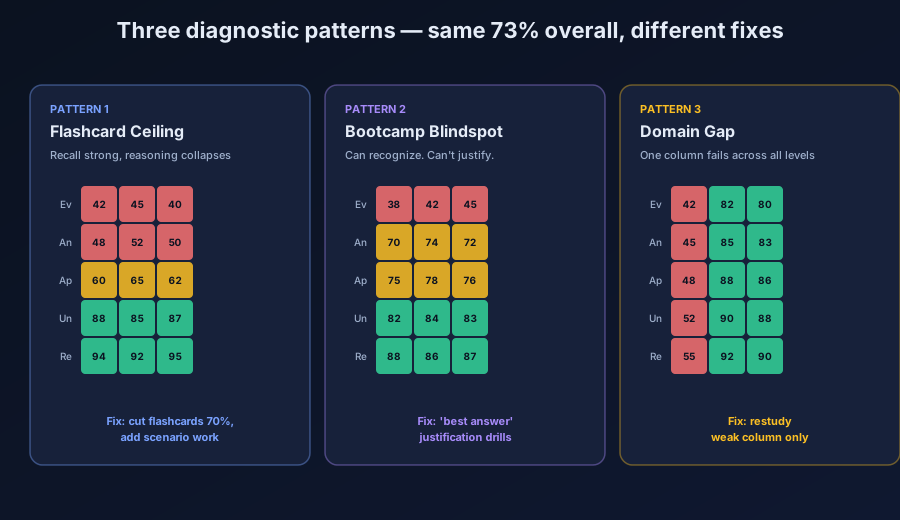
Signal: Strong Remember and Understand rows. Apply, Analyze, Evaluate degrade sharply.
Fix: Rebalance time allocation. Add scenario-based Apply work. Add distractor-analysis writeups on every practice question.
Signal: Apply and Analyze are adequate. Evaluate is in the 30s or 40s.
Fix: "Best answer" justification writing. Write the explicit argument for why one option beats another. 30 of these in a week moves Evaluate accuracy 15 points.
Signal: Otherwise strong heatmap with one weak column — a single domain weak across all Bloom's levels.
Fix: Restudy that domain with normal methods. The cognitive skill is already there — it just doesn't have material to work with.
When Your Overall Score Lies
Overall scores lie when the exam is weighted differently than your practice bank. A practice bank with 40% Remember items will let you score 73% with weak reasoning skills. The real exam, with 20% Remember items, will score the same candidate at 58%.
This is why candidates feel ambushed by real exams despite strong practice scores. Before you trust your practice score, check: does my bank match the exam blueprint? If not, your practice score is inflated.
How CIPHER Generates a Heatmap Automatically
Running the DIY version is valuable once. Running it weekly, across 100+ items, with the taxonomy applied correctly to every question, is more work than almost any candidate will actually do.
CIPHER does it automatically. Every practice session and every diagnostic produces a live cognitive heatmap:
- →Rows: Remember, Understand, Apply, Analyze, Evaluate
- →Columns: The official domains of your exam. PMP has three. Security+ has five. Each CompTIA track has its own.
- →Cells: Your accuracy, sample size, and confidence interval
- →Trend line: How each cell has moved over the last 7 and 30 days
The study plan reads your heatmap and assigns the next session to your weakest cell, using the method that trains that cell. You stop guessing what to study next. The heatmap tells you. Every session.
What You Should Do Today
If you're more than three weeks out from your exam date and plateauing:
- Run the 20-minute heatmap above. Find your pattern.
- Pattern 1 (flashcard ceiling) — cut flashcard time by 70%. Reallocate to scenario-based Apply work.
- Pattern 2 (bootcamp blindspot) — add 30 "best answer" justification writeups this week.
- Pattern 3 (domain gap) — use your existing study methods on just that domain for seven days. Redo the heatmap.
If you want the automated version — with 100+ question diagnostics, weekly re-reads, and a study plan that reallocates on its own — that's CIPHER.
Run your cognitive heatmap in 20 minutes.
CIPHER's diagnostic builds your heatmap across your exam's official domains and all five Bloom's levels. Then the study plan targets your weakest cell automatically.
No credit card required.