The First 30 Days: A Realistic Certification Study Plan
A week-by-week framework for professionals who need to pass without quitting their jobs.
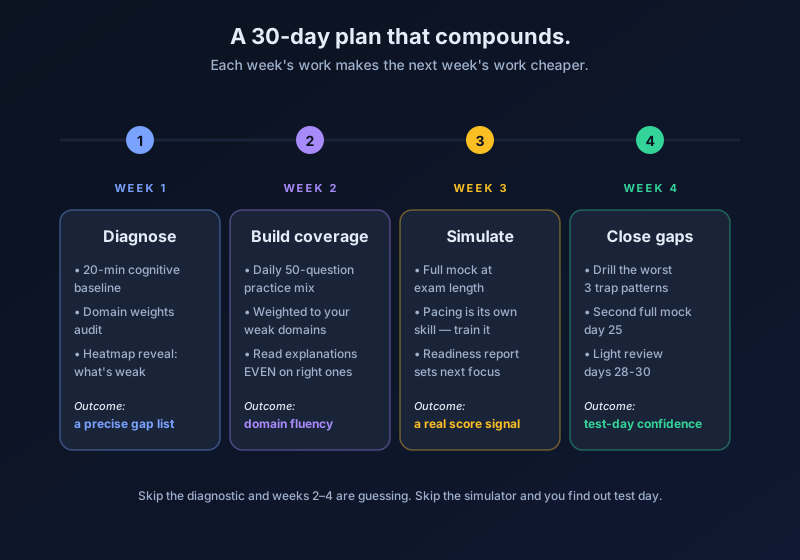
Most study plans you find online assume you have unlimited free time. "Study 4 hours per day for 90 days" is great advice if you don't have a job, a family, or a life. For the rest of us, it's fiction.
This is a 30-day study plan designed for working professionals. It assumes you have 1-2 hours per day on weekdays and maybe a longer session on weekends. It's realistic. It's structured. And it focuses on what actually moves the needle for certification exams.
This plan works for most certifications: PMP, Security+, CSM, SHRM-CP, ITIL, and others. Adjust the domain references for your specific exam.
Week 1: Foundation and Baseline
Goal: Know where you stand
Read the official exam outline from the certification body. Don't study yet — just understand what's on the exam. Know the domains, the weighting, and the question format. This takes 1-2 hours total.
Take a diagnostic practice exam (30-50 questions covering all domains). Don't study first — the point is to see where you naturally stand. Review your results by domain. This becomes your baseline.
Skim (don't deep-read) the primary reference material for your exam. Get familiar with the structure, terminology, and framework philosophy. Flag sections related to your weakest domains.
By the end of Week 1, you should know three things: what the exam tests, where you're strong, and where you're weak. This information drives everything else.
Week 2: Deep Dive on Weak Domains
Goal: Close the biggest gaps
Read the reference material for your lowest-scoring domain. Then do 20-30 practice questions focused on that domain only. Read every explanation carefully — even for questions you got right.
Same approach. Reference material, then targeted practice with explanation review.
Do a mixed-domain practice session (40 questions). This forces you to switch contexts and apply different frameworks, which is exactly what the real exam does. Review all explanations.
The temptation in Week 2 is to study the topics you already know well because it feels productive. Resist this. The biggest score gains come from improving your weakest areas.
Week 3: Reasoning Practice
Goal: Think like the exam
Focus on understanding the exam's decision-making philosophy. For each practice question, before looking at the answer, write down: "What principle is this testing?" Then compare your assessment with the explanation.
For every wrong answer you encounter, analyze why it's a plausible distractor. What makes it tempting? Understanding why wrong answers look right is just as valuable as knowing why right answers are right.
Take a full-length practice exam under timed conditions. This is your mid-point check. Compare your scores to your Week 1 baseline. You should see meaningful improvement in your weak domains.
Week 3 is where the shift happens. You stop thinking about what the answer is and start thinking about how the exam makes decisions. This is the single most important transition in your preparation.
Week 4: Refinement and Exam Readiness
Goal: Peak confidence for exam day
Based on your Week 3 practice exam, identify any remaining weak spots. Do focused practice sessions on those specific areas. This is surgical, not broad.
Full-length, timed, exam-like conditions. Treat this like the real thing. Review results but don't panic about individual questions — look at domain-level trends.
Review your notes from the past 4 weeks. Focus on the reasoning patterns, not raw content. Re-read explanations for questions you got wrong more than once.
Light study only. Cramming the night before doesn't help for reasoning-based exams. Get good sleep. Review logistics (test center location, required ID, appointment time). Trust the work you've done.
Total Time Investment
Here's roughly what this plan requires:
That's achievable for most working professionals. It's less about total hours and more about how you use them. Sixty hours of reasoning-based study outperforms 120 hours of passive re-reading.
The Key Principles
Regardless of which certification you're pursuing, these principles hold:
- →Diagnose before you study. Know your weak spots from Day 1.
- →Spend more time on explanations than questions. The learning is in the "why."
- →Study the framework's priorities, not just its content. Learn how the exam thinks.
- →Set a date and work backward. Deadlines create focus.
- →Trust the process. You won't feel 100% ready. That's normal. Take the exam anyway.
Thirty days is enough. Not because certification exams are easy — they're not. But because focused, reasoning-based preparation is dramatically more efficient than the traditional "read everything and hope for the best" approach.
Schedule the exam. Start the clock. You've got this.
Start your 30-day plan with CipherExam.
Diagnostic assessments, domain-level tracking, and AI explanations for every question. Everything you need for a focused 30-day prep.
No credit card required.