5 Study Mistakes That Cost People Their Certification Exam
Most exam failures aren't caused by lack of effort. They're caused by studying the wrong way.
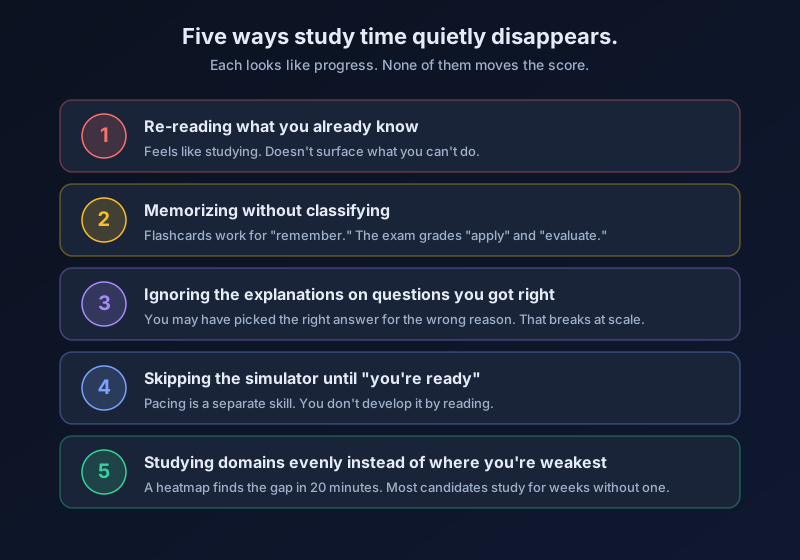
Every year, thousands of professionals sit for certification exams confident they're ready — and walk out wondering what went wrong. The failure rates for exams like PMP, Security+, and SHRM-CP are significant, and the pattern behind those failures is remarkably consistent.
It's rarely about not studying enough. It's about studying the wrong way.
Here are five mistakes that cost candidates their exam — and what to do instead.
1. Treating It Like a College Exam
In college, the formula is straightforward: memorize the material, recall it on test day, pass. Professional certification exams don't work this way.
Certifications test applied judgment, not recall. The questions present realistic scenarios and ask you to choose the best course of action based on a professional framework. Memorizing definitions won't help when every answer option sounds reasonable.
Focus on understanding how the certification framework makes decisions. For PMP, that means servant leadership and stakeholder engagement. For Security+, it means methodical risk assessment. Learn the thinking pattern, not just the vocabulary.
2. Grinding Question Banks Without Reviewing
Doing 500 practice questions feels productive. But if you're just checking whether you got the right answer and moving on, you're building false confidence. You might even start memorizing specific question-answer pairs — which is useless because the real exam uses completely different questions.
The value of a practice question isn't in the answer. It's in understanding why the correct answer is correct and why your choice was wrong.
Spend more time reviewing explanations than answering questions. After every wrong answer, ask: "What reasoning pattern did this question test? What framework principle did I miss?" That reflection is where real learning happens.
3. Ignoring Weak Domains
Human nature pushes us toward comfort. If you're strong in project scheduling but weak in stakeholder engagement, you'll naturally gravitate toward scheduling questions. It feels good to get answers right.
But certification exams test across all domains. A passing score requires competency everywhere, not mastery in one area. The domains you avoid studying are exactly where the exam will catch you.
Track your performance by domain. Identify which areas consistently have the lowest scores and spend disproportionate time there. A 10% improvement in your weakest domain is worth more than a 10% improvement in your strongest.
4. Studying for Too Long Without a Deadline
"I'll take the exam when I feel ready" is one of the most dangerous study plans. Without a fixed date, preparation stretches indefinitely. You review the same material over and over. Motivation fades. The exam feels increasingly intimidating because you keep raising the bar for "ready."
Most successful candidates report that they never felt fully ready. They scheduled the exam, prepared with focus, and trusted the process.
Book your exam date first, then work backward. Give yourself 4-8 weeks depending on the certification. Having a fixed deadline creates urgency and forces you to prioritize what matters most.
5. Using Only One Study Resource
Relying on a single textbook or one video course creates a narrow understanding. You learn one author's interpretation of the framework, which may not match how the exam frames questions. When the real exam presents a concept from a different angle, it feels unfamiliar.
Certification bodies deliberately write questions that can't be answered by memorizing one source. They want to ensure you genuinely understand the concepts, not just one author's explanation of them.
Combine multiple study methods: a primary reference guide, practice questions with detailed explanations, and scenario-based reasoning practice. The overlap between sources reinforces concepts; the differences between them build flexibility in your thinking.
The Common Thread
All five mistakes share the same root cause: studying for the exam you expect instead of the exam you'll actually face. Certification exams are designed to test professional judgment under ambiguity. They reward candidates who understand the decision-making framework and penalize those who only memorized content.
The good news is that once you shift your approach from memorization to reasoning, the exam becomes significantly more manageable. You stop being surprised by questions and start recognizing what they're really asking.
That shift is exactly what separates candidates who pass on the first attempt from those who don't.
Study the reasoning, not just the answers.
CipherExam breaks down the logic behind every question so you understand the framework, not just the content.
No credit card required.