Why Certification Exam Questions Are So Confusing
The problem isn't your knowledge. It's that most exam prep teaches you the wrong skill.
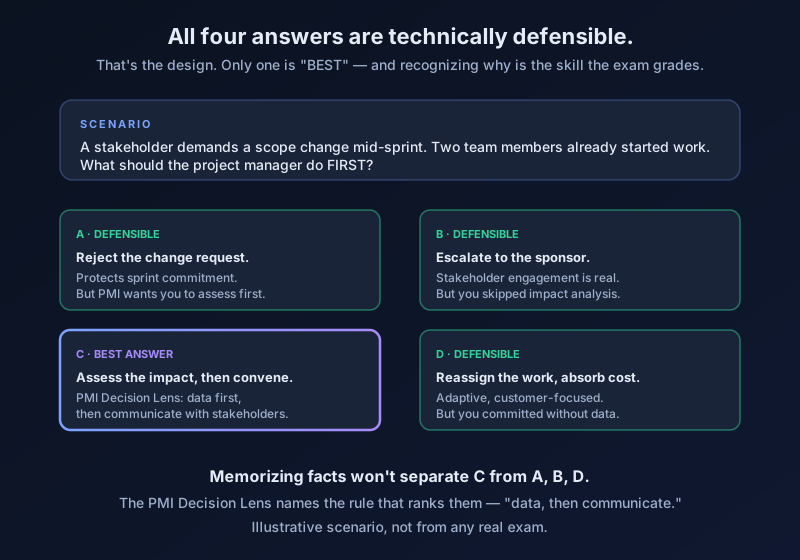
You studied for weeks. You can define every term in the glossary. You completed hundreds of practice questions. And then you sit down for the real exam — and the questions feel like they were written in a different language.
If this sounds familiar, you're not alone. It's the single most common experience among certification exam candidates, whether they're preparing for PMP, Security+, SHRM-CP, or any other professional credential.
The confusion isn't a flaw in the exam. It's a feature. And understanding why changes everything about how you prepare.
The Memorization Trap
Most exam prep tools follow the same pattern: give you a question bank, let you answer questions, show you whether you got it right or wrong, and maybe display a short explanation.
This approach works great for exams that test recall. What's the definition of a work breakdown structure? What port does HTTPS use? What does FMLA stand for?
But professional certification exams rarely ask those kinds of questions.
They test judgment. They present a scenario with multiple answers that all sound reasonable, and they expect you to choose the one that reflects a specific professional framework. The answer isn't about what you know — it's about how you think.
This is where memorization fails. You can memorize every input and output of every PMBOK process, but that won't help when the exam asks:
A project manager discovers that a team member has been consistently missing deadlines. The team member is highly skilled and has delivered excellent work in the past. What should the project manager do first?
Why C? The PMI framework prioritizes servant leadership. Before escalating, reassigning, or adjusting the plan, the PM should understand what's actually happening. Options A, B, and D skip the diagnosis entirely.
Every option in that question is a real thing a project manager might do. None of them are obviously wrong. That's the point. The exam isn't testing whether you know what HR is — it's testing whether you think like a servant leader.
How Professional Exams Actually Work
Certification bodies like PMI, CompTIA, SHRM, and Scrum Alliance spend enormous resources developing their question banks. Each question goes through psychometric analysis to ensure it discriminates between candidates who truly understand the framework and those who've just memorized content.
The techniques they use are consistent across certifications:
- →Scenario-based questions that require you to interpret context before choosing an answer
- →Plausible distractors — wrong answers that would be right in a different context
- →"Best" answer framing — all options might be acceptable, but one aligns most closely with the framework
- →Priority sequencing — "what should you do first?" forces you to think in process order
Once you see these patterns, you start to understand why the questions feel confusing. They're designed to test whether you've internalized the decision-making framework — not just whether you can recite it.
During a sprint review, a stakeholder requests a significant change to the product backlog. The development team believes the change will add substantial value. What should the Scrum Master do?
Why B? The Scrum framework is clear: changes don't go into the current sprint. The Product Owner owns the backlog. The Scrum Master's job is to facilitate the process, not approve changes. Option A violates sprint boundaries, C adds unnecessary ceremony, and D introduces a process that doesn't exist in Scrum.
Why Most Prep Tools Miss This
The majority of exam prep tools are built around question banks. You get thousands of questions, you practice them, and you see your score go up. It feels like progress.
But there's a critical problem: getting a question right by elimination or guessing teaches you nothing. And getting a question wrong with only a one-line explanation doesn't teach you the reasoning pattern you need to recognize.
What you actually need is to understand why the correct answer reflects the framework's thinking, and why your instinct led you to a different answer. That's a fundamentally different learning experience than right/wrong feedback.
Consider the difference:
"The correct answer is C."
You learn what the answer was. You don't learn why.
"You chose A because it addresses the immediate symptom. But the PMI framework expects you to diagnose before you act. The correct answer is C because servant leadership means understanding the root cause first."
You learn the thinking pattern. You'll recognize it next time.
The Pattern Recognition Shift
Here's what changes when you study reasoning instead of answers: the exam stops feeling random.
You start recognizing the patterns. "This is a servant leadership question." "This is testing whether I know the difference between a project manager's authority and the sponsor's authority." "This is checking if I follow process before taking action."
Once you can categorize the type of reasoning a question tests, the right answer becomes much more obvious — even on questions you've never seen before.
This is exactly how people who pass on the first attempt describe their experience. It's not that they memorized more. It's that they understood the exam's decision-making framework well enough to apply it in real time.
A network administrator notices unusual traffic patterns during a routine review. The traffic appears to originate from an internal source and is directed toward an external IP address on a non-standard port. What should the administrator do first?
Why C? CompTIA's security framework follows a consistent pattern: identify and assess before you contain. Blocking or disconnecting (A, B) might be necessary, but doing it without understanding the situation first could disrupt legitimate operations or destroy forensic evidence. The exam rewards methodical incident response.
What This Means for Your Preparation
If you're preparing for a certification exam, the most important shift you can make is this: stop trying to memorize the right answers and start trying to understand how the exam thinks.
Every certification framework has a decision-making philosophy. PMI prioritizes servant leadership and process adherence. CompTIA emphasizes methodical troubleshooting and risk assessment. Scrum values empiricism and role clarity. SHRM focuses on ethical decision-making and organizational alignment.
When you understand the philosophy, the questions stop feeling confusing. They start making sense. And that's the difference between someone who passes on the first attempt and someone who doesn't.
The questions aren't confusing because they're poorly written. They're confusing because they're testing something most people never studied: the reasoning behind the answer.
CipherExam teaches how certification exams think.
Every question comes with an AI-powered breakdown that explains the reasoning behind the correct answer — and why your instinct may have led you somewhere else.
No credit card required.